 The Waterlily Bear
Growing Tips For Various Water Iris Species
Jun/09/2026
Water Iris Species: Origins, Growth Habits, and How To Grow Them
Author: The WaterlilyBear - Russell T. BaerLast Updated: June 9th, 2026
Water irises are among the most elegant plants you can grow in your aquatic garden. Several distinct species are commonly grown by tub and pond gardeners, each with its own native range, preferred water depth, flowering period and growth character. Knowing which species tolerate standing water and which prefer moist-but-not-submerged soil is essential before you decide whether to plant one alongside your water lily in a tub water garden - or keep it in a separate, dedicated container.
Choosing the Right Iris for Your Tub Garden
If you want to add an iris directly to a tub water garden already home to a water lily, Blue Flag, Southern Blue Flag and Yellow Flag are your most compatible choices. They are genuinely semi-aquatic and handle the consistently submerged wet conditions without complaint. Louisiana water irises in general are tolerant of constantly wet feet.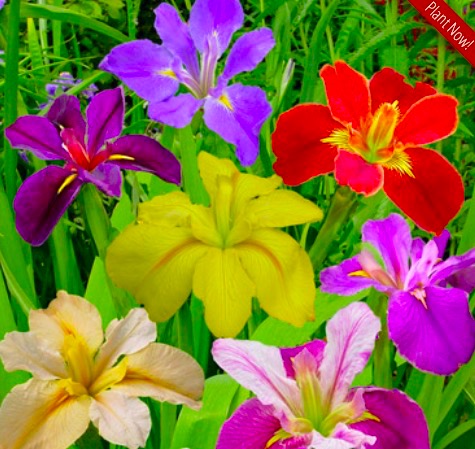
Get Water Iris Plants or Seeds Online
Louisiana Water Iris Plant Collection
View on Amazon
#AD
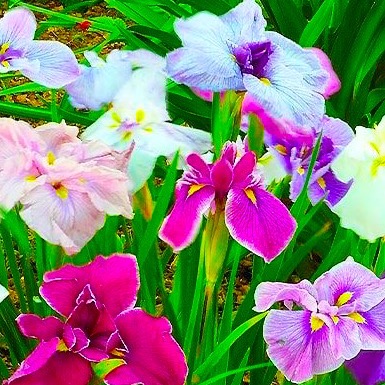
Japanese and Siberian irises are more emergent - 'Living On The Edge' of ponds with roots only seasonally submerged - and their rhizomes and crowns kept WELL ABOVE the waterline. They may require their own dedicated containers where you can fine-tune water levels across the seasons. Growing them in a separate pot set on bricks or a shelf at the pond's edge allows you to lower or raise the rhizome and root water levels as each species demands, giving you the best chance of strong bloom and long-term plant health. The major water iris species grown in North American gardens include:
- Northern and Southern Blue Flag Irises
- European Yellow Flag Iris
- Louisiana Iris
- Japanese Iris
- Siberian Iris
- Pseudata Iris Hybrids
Blue Flag Iris
Native to wetlands and marshy meadows across eastern and central North America, Blue Flag (Iris versicolor) is one of the most cold-hardy and reliably aquatic of all the iris species. It grows in clumping fans of upright, sword-shaped foliage reaching two to three feet tall and produces violet-blue flowers with distinctive yellow and white markings at the throat. In the wild it grows along pond edges and stream banks where roots are frequently submerged. In the tub garden, Blue Flag tolerates standing water of two to four inches over the crown and coexists happily alongside water lilies without competing aggressively. It is an excellent choice for a shared container.Southern Blue Flag Iris
The Southern Blue Flag (Iris virginica) is Blue Flag's close cousin, native to the coastal wetlands and swamps of the southeastern United States. It is slightly more tolerant of heat and less cold-hardy, making it particularly well-suited to Zone 6 through Zone 9 gardens. Growth habit is similar — upright fans, two to three feet tall, with lavender-blue flowers. Like I. versicolor, Southern Blue Flag is genuinely semi-aquatic and handles standing water over the crown comfortably. It is a solid companion plant for a water lily tub, especially in warmer Southern climates.Yellow Flag Iris
Originally from Europe, western Asia, and North Africa, Yellow Flag (Iris pseudacorus) is the most aggressive aquatic iris species commonly grown in water gardens. It thrives in standing water up to six inches or more over the crown and can spread rapidly by seed and rhizome in open water situations. While its bold yellow flowers are striking, this species is considered invasive in many parts of North America and should be managed carefully in natural ponds. In a contained tub garden it can grow alongside a water lily, but its vigorous spreading habit means it should be kept in its own pot even when submerged in a shared container.Louisiana Iris
Louisiana irises are not a single species but a complex of five native species — primarily Iris fulva, Iris giganticaerulea, and Iris brevicaulis — native to the Gulf Coast wetlands and river bottomlands of Louisiana and neighboring states. Their modern hybrids offer an extraordinary range of colors from copper and red through white, purple, and near-black. Louisiana irises prefer moist to wet soil and will tolerate shallow standing water of one to two inches over the crown during the growing season, but they do not like prolonged deep submersion. They perform best in a dedicated container where water levels can be lowered slightly during dormancy. Not the easiest companion for a standard water lily tub.Japanese Iris
Order Water Iris Plants and Seeds Online
Japanese Water Iris Collection
View on Amazon
#AD
Siberian Iris
Siberian Iris (Iris sibirica) originates from central Europe through Russia and central Asia, where it grows in damp meadows and alongside streams rather than in standing water. It is the most terrestrial of the commonly grown water garden irises, preferring consistently moist but well-drained soil. While it will survive briefly wet conditions, Siberian iris does not tolerate prolonged submersion and will decline if its crown sits in standing water for extended periods. Like Japanese irises, it is best kept entirely separate from a water lily tub, grown in its own container or in a bog garden area where it can be watered heavily but not submerged. Its elegant, narrow-petaled flowers and graceful foliage make it worth the extra management.*NEW* Pseudata Hybrid Iris
Recent advancement in genetic understanding has led to successful crosses between the European Yellow Flag (Pseuacorus) and Japanese water iris (Ensata) family. This is a big deal for water gardeners because it allows for the best characteristics of Japanese water iris with their huge flowers to have the submerged water tolerance and vigorous growth characteristics of the European water iris. These new Pseudata iris hybrids can better handle being IN water instead of preferring to be ABOVE the waterline. Some of the handful of these new hybrid Pseudata irises have cultivar names such as - and can be found on eBay and select water gardening nurseries. They may be worth exploring if you want to expand your collection of aquatic botanicals.Which Waterlily Cultivar? Pland ID Identification Tips
Jun/06/2026
Help Identifying Waterlily Varieties: Plant ID Identification Guide
Author: The WaterlilyBear - Russell T. BaerLast Updated: June 6th, 2026
Unique Ways To Identify A Waterlily Variety
How do you even begin to accurately identify a waterlily? Most people fall in love with water lilies through their blooms, and who can blame them? A perfectly formed Nymphaea flower floating above still water is one of the genuinely spectacular things a water gardener can produce. But if you're trying to figure out exactly what you're growing, the flower alone might often leave you guessing. There are many hybrid water lily cultivars that have been around for decades, or even over a century. These have well known traits that help make many old classics instantly recognizable. However, new hybrids are always being developed not just in the western world: Thailand and Singapore have actually become the centers for waterlily breeding introducing new varieties at an astounding and rapid pace.This season, The WaterlilyBear is growing over 20 varieties in patio tub gardens here in the desert Southwest. Some are attempts to revive some of last year's tropical tubers. Tropicals are often treated like annuals, but during spring repotting and clean up, I pull old tubers out of the muck, throw them in a bucket of water, and get them all mixed up! Those that do recover may take until mid season if and when it blooms to ascertain what variety it is.
Serious water lily identification requires reading the whole plant. Once you start looking beyond the blossom, you'll discover a surprisingly rich set of characteristics that vary dramatically from cultivar to cultivar - details that are hiding in plain sight on the surface of every pad, along every petiole, and even underground in the tuber itself. This waterlily identification guide walks you through the bigger picture, from the roots up.
Waterlily Tuber Characteristics
The tuber is where a water lily lives when it isn't performing for an audience, and it turns out to be a surprisingly useful identification tool - if you're willing to get your hands muddy.Hardy water lily tubers generally fall into a few structural types. Some are elongated and rhizomatous, creeping horizontally through the soil container. Others are more upright and compact, sometimes described as pineapple-type for the way the growing crown sits at the top of a dense, rounded rootstock. The branching habit varies too.
Tropical water lilles are different, always planted upright. Some cultivars produce a single dominant tuber while others like night-blooming tropicals offset aggressively, throwing out multiple growing points and forming new tubers near the mother plant.
What a lot of people don't realize is that tuber surface texture can also vary between cultivars. Some are relatively smooth, while others have a noticeably rough or even slightly fuzzy surface texture from fine root hairs and surface trichomes. It's not something you'll find in most catalog descriptions, but once you've handled enough varieties you start to notice it. Some tropical cultivars tubers are as fuzzy and hairy as the Waterlily Bear is! When you're repotting your tub garden containers in spring, this is actually a great time to get familiar with what your specific cultivars look and feel like at the root level.
Tuber color and the color of the interior flesh when cut can also vary, ranging from creamy white to yellowish to distinctly pink-tinged in some red-flowering varieties. None of this is definitive on its own, but combined with other characteristics it adds another data point to your identification toolkit.
Lily Pad Petiole Color and Characteristics
The petiole is the stem connecting the pad to the tuber, and it is one of the most underrated identification features in the entire plant. Pull a pad off the surface and look at what's holding it up - you may be surprised at what you find.Petiole coloration ranges from solid green through various degrees of red or purple striping, to fully pigmented stems that are deep burgundy from top to bottom. In some cultivars the pigmentation is subtle and only visible when you hold the stem up to light. In others it's vivid and unmistakable.
More surprising to most people is that petioles can be smooth or noticeably hairy. Some cultivars have fine pubescence - a fuzziness - along the petiole surface that is clearly visible if you look closely and easy to feel when you run the stem between your fingers. This is a genuine taxonomic characteristic that extends back into the plant's species parentage, and it's the kind of detail that simply doesn't make it into most water lily content anywhere online. In the WaterlilyBear's tub garden collection, petiole pubescence has actually helped confirm the identity of cultivars where the flower character alone wasn't enough to close the case.
Petiole diameter and rigidity also varies. Some cultivars have thick, sturdy stems while others produce surprisingly slender petioles relative to the size of the pad they're supporting. One surprisingly vigorous white hardy waterlilies I grow has very thin, brittle, crisp petioles that often just break when I'm trying to rearrange the lily pads to fit neatly in a tub garden!
Lily Pad Topside: Shapes Colors, Pigment Patterns, and Margins
The top surface of the pad is where most people focus when they look beyond the flower, and it does offer a lot of useful information - you just have to know what you're looking at. Shape alone can tell you alot: Hardies are often very round - where at the other extreme, night blooming tropicals commonly have very oblong, often pointed rather eye-shaped leaves, especially small young ones.Base color ranges from fresh apple green through olive, deep forest green, and in some varieties a distinctly bronzy or reddish-green tone, especially in new growth. Many cultivars show mottling or speckling - irregular patches of purple, maroon, or brown overlaid on the green ground color. This mottling can be dense and dramatic, as in Nymphaea 'Pygmaea Helvola' with its heavily marked small pads, or sparse and subtle, present mostly on young leaves and fading as the pad matures like the tropical lily 'Panama Pacific.'
The pigmentation itself likely serves a functional purpose beyond just looking interesting. The leading theory is that purplish anthocyanin pigments in young water lily pads act as a kind of sunscreen, protecting the developing leaf tissue from intense UV exposure before the green chlorophyll-producing structures are fully developed - which, if you're growing in the desert Southwest where UV is genuinely brutal, makes the pigmented new growth on your tub garden plants more than just a pretty detail. It may also play a role in deterring insect feeding on the more vulnerable young tissue.
The pattern type matters too. True mottling is irregular and blotchy. Speckling is finer and more evenly distributed. Some cultivars, dark blue or red tropicals in particular, often show streaking - elongated pigment marks that radiate outward from the center. Getting familiar with these distinctions helps you narrow down possibilities quickly when you're working with an unlabeled plant.
Pad margins are another useful feature. Hardy water lily pads typically have smooth to slightly wavy edges. Tropical varieties more commonly show pronounced waviness or even saw-toothed serration along the margin - that ruffled, almost frilly edge is a reliable signal that you're looking at a tropical rather than a hardy. The sinus - the notch cut into the pad where the petiole attaches - can be open and wide, narrow, or even overlapping, and sinus shape is consistently cultivar-specific enough to be genuinely useful.
Lastly, look for little nubs forming at the very center of the lilypad where it attaches to the petiole. Cetain viviparous tropical varieties can form small new plantlets worth saving for easy propagation.
The Underside of the Pad: The Surprise Feature
Turn a lily pad over and prepare to be caught off guard. The underside of a water lily pad is frequently a completely different color than the top surface, and the contrast can be dramatic enough to make you think you're looking at a different plant entirely.Many cultivars show deep purple, burgundy, or wine-red coloration on the pad underside regardless of what the topside looks like. A pad that's solid medium green on top may flip over to reveal a rich reddish-purple underside. In some tropical varieties this coloration is particularly intense, with vivid pigmentation covering the entire lower surface and extending along the veins in a contrasting pattern. In the WaterlilyBear container watergarden collection, flipping pads has become almost a reflex - it's too useful not to do routinely.
The veining itself is often more visible and distinct on the underside. The radiating pattern of veins from the petiole attachment point varies in prominence, spacing, and whether the secondary veins are visible to the naked eye. Some cultivars also show surface texture differences between the two faces of the pad, with the underside having a slightly different sheen or more texture than the topside.
Why does this matter for cultivar identification? Because most photos of water lilies - in catalogs, on websites, in social media posts just show the top of the pad and the flower. The underside almost never appears in documentation. Which means if you're growing an unlabeled cultivar and you've checked every visible characteristic against every photo you can find and you're still not sure, flipping the pad over may give you the one detail that closes the case.
The full picture of a water lily cultivar lives in all of these layers together. Flower color and form gets you in the neighborhood. Pad markings and margins narrow it down. Petiole color and texture, tuber structure, and pad underside coloration are what get you to a confident identification. Grow enough varieties in your patio tub gardens and examine them closely enough, and you'll start reading these characteristics automatically - the whole plant becomes the field guide. TIP: AI Chat Bots can be surprisingly helpful in narrowing down exactly or most likely what variety it is, but you have to give it all the above observable characteristics in a carefully worded prompt.
Most Popular Best-Selling Waterlily For 150 Years!
May/14/2026
Nymphaea 'Chromatella' Waterlily : A History
Author: The WaterlilyBear - Russell T. BaerLast Updated: May 14th, 2026
What is the best selling waterlily variety of all time? 'Chromatella' (aka 'Marliacea Chromatella') #Ad is arguably the most iconic hardy waterlily in the Western World of horticultural history. The story of this popular yellow hardy water lily runs through the most important names, places and events in modern waterlily history. In the northern hemisphere, white was the ONLY color of native waterlilies in the cool temperate regions.
Chromatella was bred by Joseph Bory Latour-Marliac at his nursery in Temple-sur-Lot, France, and developed around 1877 making it one of his earliest and most successful cultivars.
Marliac was the first person to successfully hybridize hardy waterlilies, a feat seemingly impossible at the time that many suspected he'd invented a secret technique. He essentially had, taking his hybridization methods to his grave. Its parentage remains uncertain, but is generally believed to involve the white Nymphaea alba and possibly the yellow-flowered N. mexicana from much warmer regions. Chromatella became celebrated for its sulfur-like, soft canary yellow blooms, beautifully mottled and marbled lily pads, reliable flowering performance, and remarkable cold hardiness.
Marliac's Rainbow Of Waterlilies Introduced To The World
In 1889, Marliac exhibited his colored hardy waterlily hybrids at the Paris Exposition Universelle. It was the same world's fair that unveiled the Eiffel Tower and celebrated the 100 year anniversary of the French storming the Bastille. European and North American horticulturalists were stunned that hardy lilies could exist in pinks, yellows, and reds - and not just the native white N. alba. Marliac won major exhibition awards at the expo and his nursery was put on the world map overnight.Artist Monet Made Marliac's Hybrid Waterlilies Famous
It is believed the expo was where Claude Monet first encountered Marliac's lilies, igniting his fascination and leading to his purchase of plants for his home garden pond at Giverny, a small village in Normandy, France. Monet lived there from 1883 until his death in 1926.Monet's Paintings Featured This Yellow Waterlily
There, Monet constructed an elaborate water garden with a Japanese-style bridge and lily pond, planting Marliac's cultivars including Chromatella. He didn't paint from imagination: He built the pond, planted the lilies, and painted what he saw from his own garden for decades, producing the legendary Water Lilies (Nymphéas) series. The warm canary yellow blooms visible in paintings such as the 1916 "Water Lilies" are widely believed to represent Chromatella specifically.Most enduringly, his ponds and gardens at Giverny today are a major tourist destination preserved to reflect Monet's lifetime. His art has graced museums around the world and to this day, the Chromatella Waterlily #Ad remains in wide commercial production and availability nearly 150 years after its introduction. It's a remarkable legacy shared by few plants in western horticultural history. The Waterlily Bear grows it in his patio watergarden as a tribute to Marliac and Monet's roles in water gardening history@
Water Gardening Tips For Desert Regions : Lily Pond Survival Guide
May/06/2026
Desert-Friendly Water Gardening Tips
Is desert watergardening an oxymoron? If you’re in an extreme and hot, dry climate like the desert Southwest, water gardening can be challenging! The Waterlily Bear has moments thinking he should be growing cacti and succlents like normal desert gardeners. Managing sun-drenched patio ponds baking in the desert heat and gently poaching goldfish and waterlilies can be both beautiful and manageable with the right choices and care of your pond.1. Choose Desert-Adapted Pond Plants
Opt for flower colors, cultivars, and species that tolerate heat, full sun, and high UV radiation levels. Examples include Hardy water lilies (Nymphaea spp.) which can easily survive mild winters. Hardies perform best in spring and fall. Extreme summer temps often inhibit flower bud formation during the most brutal months of heat extremes in the desert. That may be okay, because that's when tropical water lily varieties are happiest and are in their peak blooming phase.Tropical waterlilies with lighter colored petals (e.g., Pale Blue, Pink, Yellow and White) Tropical waterlily blossoms will hold up better midsummer than dark red, blue or purple lily flowers that absorb the intense sun and infrared radiation a bit too readily.
Sacred Lotus (Nelumbo nucifera or N. lutea) are quick to sprout in water and can handle heat. But above-ground tub and container water gardens expose the root rizhomes to more extreme daily temperature swings that might ihibit lotus flowering and bud set. Consider sinking a small tub garden into the sand and gravel to mitigate root temps for improved growth and flowering in the desert.
Marginal bog plants like arrowhead (Sagittaria latifolia), pickerel rush (Pontederia cordata), and cattails (Typha spp.) can add vertical hight and interest, varied leaf shapes and texture. They hold up well here in the Mojave / Sonoran Desert region.
Heat-tolerant perennials such as Texas star hibiscus (Hibiscus coccineus), garden cannas (Canna hybrids), and purple coneflower (Echinacea purpurea).
2. Container Water Garden Advantages In The Desert
There are many advantages to mini-pond water gardening in a desert climate. Tub gardens can be partially drained and moved over the course of the growing season if needed to compensate for changing angle of the sun. Successful water gardening in the desert often hinges on taking advantage of less intense early morning sun - then shade protection during the worst of afternoon heat.For small spaces, use heavy, mucky black potting soil in a tub or container. This retains moisture and nutrients better than light soil or desert sands. Ensure pots have drainage holes and a liner to prevent soil from washing out - but are able to breathe and release gases from decomposing organic matter as soil temps rise during the day.
3. Sunlight & Water Management
Provide a minimum 4–6 hours of direct, full morning sun daily for most tropical and hardy lilies to bloom well. Some varieties are known for for flowering well in semi-shaded areas.In summer, evaporation and plant transpiration rates will be high. Desert soils and water sources tend to be alkaline, you may see mineral buildup on the lilypads. Top-off water daily and allow ponds to overflow to dilute and flush out mineral accumulation.
During the absolute extremes of high summer desert temps (normally in July and August) - You may want to use shade cloth or a pop-up canopy to minimize direct sun exposure during the heat of the afternoon. Blooms will get fried, lilypads will get crisp around the edges when temps get above 110F.
4. Mild Desert Winter Pond Survival Guide
Some tropical water lilies can survive mild winters in the Mohave and Sonoran Deserts if the water stays above freezing. Frosts and freezes are rare in the low-desert. At higher desert altitudes and during colder snaps, a fabric cover can be used temporarily.5. Desert Pond Maintenance
Such warm desert growing conditions favor rapid growth. Trim dead leaves regularly to minimize diseases, algae buildup. Remove excess plant matter to avoid stagnation.Use small goldfish and snail population for natural algae control, but keep numbers low to avoid overgrazing.
Avoid over-fertilizing! Aquatic plants in containers benefit from fertilizer tabs pushed into the soil. Jobe's and Miracle Gro mini sticks for flowering plants work gently and reliably. Pond tabs however should be pushed deep into the soil around the pot's edges - Not close to the crowns.
6. Pest & Disease Prevention
Keep water clean and flush it periodically to reduce algae and pests. If a pond's ecosystem gets out of whack, drain 3/4th's of a pond's water - without disturbing the sludge at the bottom, and refill to do a reset of the biological balance.Watch for aphids or excess snails; remove by hand or use natural predators. Lizards and desert rats will sometimes munch on lily pads or pond plants in the middle of the night.
Ensure good air circulation to prevent fungal issues on foliage. Generally not a problem in the low-humidity of the desert. However, Crown Rot is a soil borne fungus and can kill waterlily plants as the fungi invade the tuber and growing point.
7. Aquatic Plant Propagation
Divide tubers and repot lotus and waterlilies in late winter for new plants. January and February are good times to repot to allow pond plants to establish root system before temps warm and water gardening season kicks in. Plant tropical waterlilies in March or April when water temps consistently hit 70F+.Propagate lotus from seeds or healthy sections of rizhomes with growing points. Hardy lilies can be divided anytime from tuber divisions.
By selecting heat-tolerant species and, using optimally placed pond containers with good soil, and managing water quality carefully, you can enjoy a vibrant, low-maintenance water garden even in the desert heat.
Where To Find Marginal And Pond Plants Near Me
Apr/23/2026
Get Free Pond Plants Near Me?
You might be able to source popular floating, bog, marginal and aquatic pond plants near you at a low-cost or even free. Finding a local source of pond plants may be ideal because they're likely to be optimally suited for your particular growing zone and climate. If they grow and thrive nearby, they'll surely grow and perform well in your local environment and water gardening adventures.Local Pond Plant Sources
I would ask myself: "Where can I get some interesting pond plants near me? - Were can I locally source aquatic water garden plants for my pond nearby?" Well, put on your thinking cap and ponder where in your neighborhood or region a desirable water plant is likely to be found growing and available. Think of nearby lakes, marshes, bogs and riverfront areas you could gain access to that might have a surprising variety of popular shallow water plants for your pond's setup.Gathering Pond Plants From Nature
Far be it from me to advocate a lawless life of gardening enthusiast thievery. You just can't go mucking about on public lands, national or municipal parks and dig around in the mud for for water gardening plants or critters in nearby bogs, ponds, lakes or rivers. But you CAN grab a shovel, dig in the muck and do it on private land with the consent of the owner for free - or maybe you have to bribe them with 5 bucks for access. Ethically and Legally sourced, organically grown aquatic plants near you for your water garden are an option!Water Garden Plants I've Found Near Me
An outing for 5-finger discount water plant shopping might be exploring nearby lakes, river flats and ponds where owners will grant waterfront access. When I was MacGizmoGuy, I had a computer client with a lakeshore home that had purple pickerel plants (Pontederia Cordata) and broad leafed arrowheads (Saggitaria Latifolia) in the shallows around their dock and shoreline - with native white waterlilies (Nymphaea Odorata) slightly further out. They considered them a nuisance that impeded their swimming and boating activities - and were more than happy to share some. A friend who lived 2 miles down the gravel road from me had native Blue Flag irises (Iris Versicolor) growing in the ditch alongside her driveway. Score! In short, I found the plants I needed near me - and using a large rubberized farm animal feeding tub - I created a little mini water garden pond I could view just a few feet away from my woodland cabin's back window.Pickerel Weed Colors: Purple White & Pink Pickeral Rush
Apr/12/2026